

Some founders come from accelerators, pitch decks, startup podcasts, and know exactly how to say go-to-market motion without laughing.
Then there are others that come from 20 years inside a broken industry, and they’ve watched the same problem happen over and over and over and over. These founders saw smart people using bad systems that just kept breaking.
They watched families, customers, employees, patients, students, or teams suffer through something that should have been easier. Then one day they stopped saying someone should fix it, and they just freaking fixed it.
This group of founders is really some of my favorites. They’re not behind, and they’re not less sophisticated because they don’t speak the jargon. They often actually understand the customer and their problem better than anyone who learned from just a market deck or Silicon Valley language. They know the weird edge cases that nobody else sees unless you’re in the dirt with them. They know the emotional stakes. They know what people say in meetings and they know what people actually do when a system fails.
THAT IS GOLD.
Now this is the part where it gets hard, because that same depth that makes them brilliant can also put them at the center of everything in the company that they’ve built. They quickly become the translator for every department.
The sales team needs their context.
The product very much needs their judgment and understanding of the client.
Engineering needs their explanation to execute.
Customers want them front and center because they trust them, and then the team all wants their approval.
Suddenly, the founder who wanted to fix a problem is spending their days answering questions, clarifying decisions, smoothing over handoffs, and trying to remember why something was promised six weeks ago.
They didn’t do anything wrong, but their knowledge never got turned into a system. They might be digging for solutions with AI or blogs from other SaaS experts, but it just isn’t clicking.
Can we just admit something?? Startup language is weird! Acronyms make normal people feel like they walked into the wrong classroom halfway through the semester.
ICP
PLG
GTM
NRR
CAC
LTV
Cool, but underneath most of those terms are really normal business questions, and those get lost. Really, what those terms come down to is:
Who are we selling to?
How do customers find value?
What happens after someone buys?
Are people staying?
Are we making money in a way that makes sense?
Do we know what’s working?
This is where I love working with founders like this.
They do not need someone to come in and make them more “startup-y.”
(Pleaseee no.)
They need someone who can sit between the founder’s hard-earned industry wisdom and the company that now has to execute around it.
Someone who can translate founder instinct into team clarity.
Customer nuance into onboarding.
Sales promises into delivery reality.
Gut feeling into a simple operating rhythm.
Cross-functional weirdness into “Here’s who owns this, here’s where it lives, and here’s what happens next.”
If this is you, I hope you know this:
You built something real.
You saw a problem other people tolerated and decided to do something about it.
That is not small.
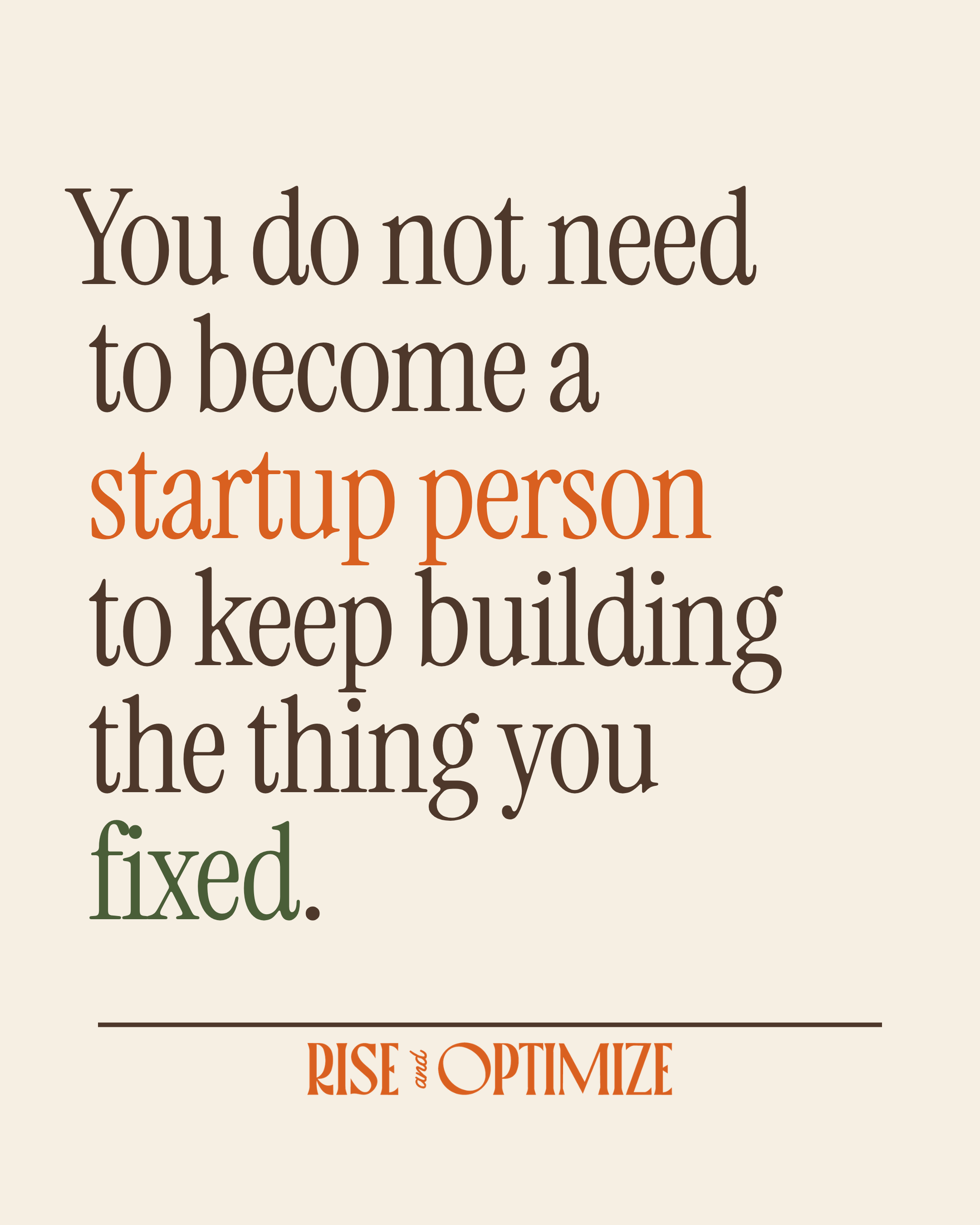
You do not need to become a startup person to keep building it (promise), but the company does need a way to operate without everything living inside your head.
That is the next version of the work. Making what you know easier for everyone else to carry.
If part of your company still mostly lives in your head, reply and tell me what it is. That’s usually the first place the next system needs to go.
I appreciate your thesis here and hopefully motivates others with experience to just start!
The founders who need this most are often the ones who built their whole identity around being the one who knows. That expertise is the thing they trust when everything else feels uncertain. So stepping back from center feels like giving up the one thing they're confident about.
The ones who make the shift fastest are the ones who get genuinely curious about what the org can figure out without them. They start treating absence as a diagnostic tool. Have you seen a pattern in what actually triggers that shift?