

Thanks for hanging with me through my brief pause last week to wander the streets of Barcelona and Girona, Spain. Not going to lie, it was lovely to turn down the notch on my own tool stack and soak up the history and explore. In standard me form, I couldn’t turn it all the way off and found some comparisons to my experience in those beautiful streets. Can’t take the ops out of the girl. ;)

Now back to our regularly scheduled programming! This is Part 3 of Leaks in the Lifecycle, my breakdown of the silent operational gaps that cost early-stage startups real money. If you missed Part 2 on the Phantom Handoff leak, you can check it out here.
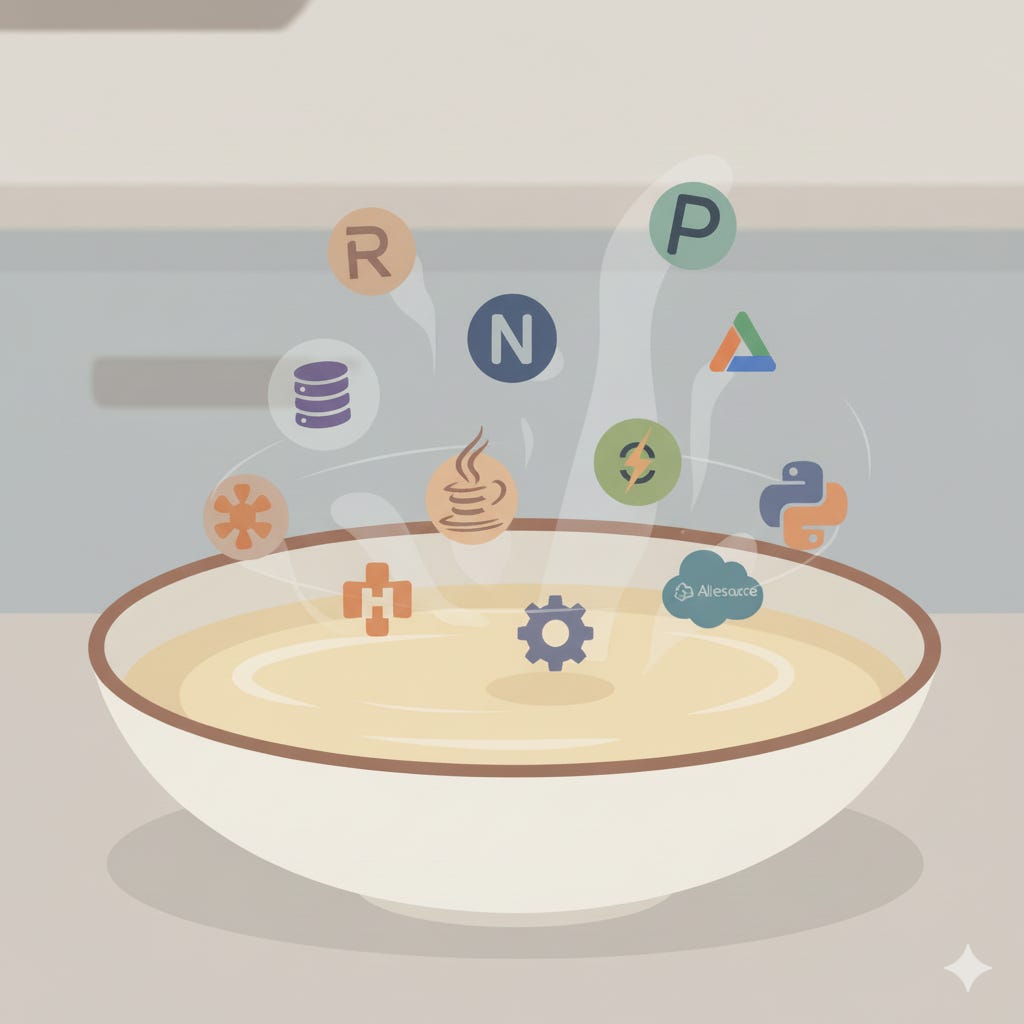
Today’s culprit: Tool Soup.
🍲 What Is Tool Soup?
Tool soup is when your startup’s tech stack looks more like a tasting menu:
A department stood up Airtable for their workflow… while everyone else documents in Notion.
You bought HubSpot’s full suite, but still pay for Intercom, even though HubSpot could cover most of that.
Someone subscribed to a point-solution AI tool when GPT could’ve done the job (and 10 other things).
It’s not just too many tools. It’s no clear system for how they’re used, no onboarding for new hires, and zero ownership when things break.
👀 Signs You’ve Got Tool Soup
No source of truth. Sales is in HubSpot, CS is in Intercom, Product is in Slack DMs. Nobody knows what’s real.
Duplicate effort. Data gets entered twice, sometimes inconsistently.
Lost context. Client conversations in Intercom never reach HubSpot. Product feedback never reaches engineering.
No owners. The person who set up FreshBooks left six months ago, and now no one knows who maintains it.
Your team’s day-to-day feels like: “Where do I find this?” → “Who owns this?” → “Wait, which version is right?”
💸 Hidden Costs
Tool soup is sneaky. It doesn’t always appear to be a crisis until it has become full-blown.
Time wasted: Hunting down contracts, renewal dates, or client notes.
Money wasted: Licenses for tools nobody owns anymore.
Revenue lost: Missed invoices, dropped renewals, and onboarding delays.
💡 Real Story: At one SaaS company, invoices were scattered across FreshBooks, HubSpot, and Stripe. Nothing connected. When I came in, several invoices had gone unsent or unpaid. We moved everything into Stripe, linked it to the platform, and suddenly, collections became visible and manageable. ARR recovered, and the manual guesswork came to an end.
🛠 How to Fix Tool Soup (Without Going Full Marie Kondo)
Start stupid simple:
✅ Audit your stack. List every tool, its purpose, and who owns it. If no one owns it → it’s already a leak.
✅ Document purpose + access. Put it in your team handbook (Notion, Drive, whatever). Include onboarding videos and vendor resources so people don’t have to relearn the basics.
✅ Assign ownership. Every tool needs an owner, even if it’s part-time. Ownership is what prevents waste.
✅ Quarterly check-ins. Sit down with vendors (they want to help you succeed) and with your own team to confirm the tool is still doing its job.
You don’t need a tool for every little thing.
Early on, Notion, Airtable, or even Google Drive can carry a significant amount of weight if paired with effective systems. You can layer in more details later, but only with a solid structure.
☕️ Spicy Take
If your startup has more tools than employees, you don’t have a stack. You have chaos disguised as productivity.
👀 What to Do Now
Take one hour this week.
Do a quick audit of your tools.
Kill the duplicates, assign ownership, and document the purpose.
If you’re not sure where to start, I’ll help you figure out where your stack is leaking:
👉 riseandoptimize.com/chaos
Next up:
Leak #3: The “We’ll Just Figure It Out” Onboarding Trap. Why custom onboarding breaks your business before it scales.
So true! I’ve been working on exactly this for a client. Creating a knowledge base that connects and makes sense of the full tech stack and trims it down, so that its clear rather than overwhelming, and audits for the same check points you mentioned. If possible, it should be done preemptively before upgrading and adding to a stack.
This really resonates with me, Katie!