


Welcome to Operator Questions for Founders, a (new) recurring series where I ask founders the questions I usually get to ask only after I’m already inside the company:
What did you hire too early?
What did you hold onto too long?
Where did “scrappy” stop working?
What did growth expose that you couldn’t see when the company was smaller?
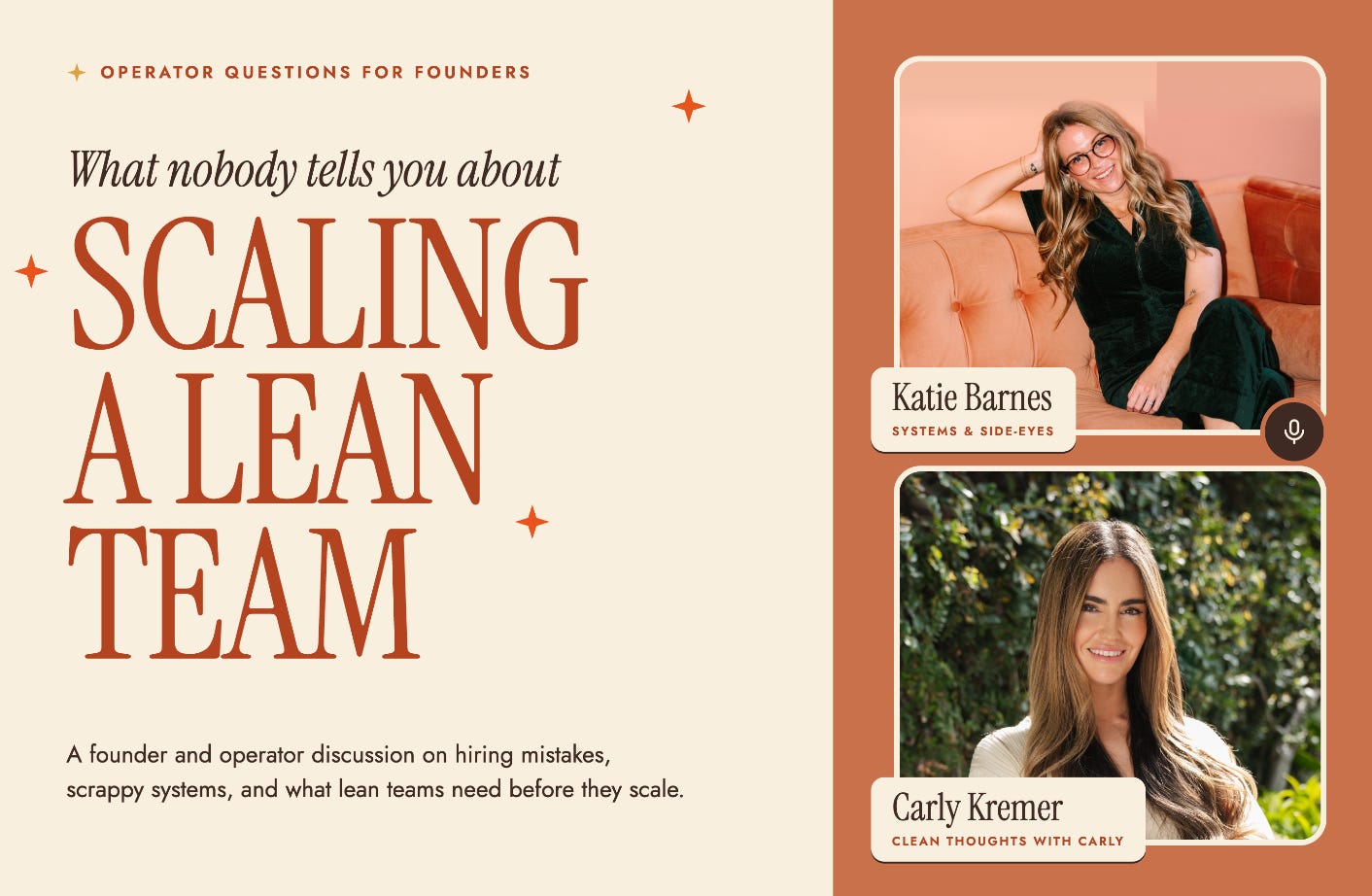
For the first issue, I talked with Carly Kremer, founder of Beekeeper’s Naturals.
Carly has spent nearly a decade building Beekeeper’s from the founder seat, which means she has the kind of operating scar tissue I care about: expensive hiring lessons, places where running lean worked brilliantly, places where it became an overcorrection, and a very real test of whether the company could keep moving when she stepped away.

I’ve spent most of my career walking into companies after the “we’ll figure it out as we go” phase starts showing cracks.
So when Carly and I started comparing notes, we kept coming back to the same thing:
Founders can spend an extraordinary amount of money trying to solve problems they haven’t actually diagnosed yet.
A big hire. An agency. Another tool. Another layer of management.
Sometimes that absolutely is the answer.
Sometimes somebody just needed to ask: Wait. What exactly is broken here?
That’s what I wanted to get into with Carly: the decisions founders usually understand much better after they’ve already paid for the lesson.
More people can make a messy system more expensive
I asked Carly:
When you think back over almost 10 years of building Beekeeper’s, where have you spent money because you thought adding a person would solve a problem that you later realized was actually a structure or clarity problem?
Her answer immediately went to marketing.
“It’s challenging because sometimes the skillset for creativity and strategy is very different from organized and execution oriented. Also it can be very compelling to work with agencies who have amazing pitches and specialize in areas you need to grow but you can quickly drain cash if you aren’t crystal clear on what you want the agency to solve, how they have an edge or create value you can’t generate on your team and they require ongoing oversight.”
She also said:
“People can have the best ideas but if there isn’t follow-through on who does what throughout a campaign; things can come out half-baked. Another issue can be lack of tracking. Results need to be analyzed and used to inform future decisions and sometimes that’s not intuitive for creatives who want to move quickly to the next exciting idea.”
This was the part I underlined:
“Sometimes adding an extra person actually creates more of a bottleneck.”
That is one of the biggest patterns I see from the operator side, too.
A vague problem creates a vague role.
Then you have an expensive person trying to invent their own job while the founder is sitting there six months later wondering why nothing feels easier.
Before I recommend adding headcount, I want to know:
What is actually breaking?
Who owns it today?
What outcome are we trying to change?
Is this truly a capacity problem?
Or is it an ownership, process, or decision problem?
Headcount can cover up operational problems for a surprisingly long time, but it makes them a heck of a lot more expensive.
The big logo on the resume is not the job description
This is one Carly and I are both a little spicy about.
I asked her:
You mentioned seeing founders get excited about candidates with huge companies on their resumes, and how they spend aggressively without really knowing whether that person can build in an early-stage environment. What have you learned about evaluating people for a lean team?
Her first point was simple:
“Step one is understanding the holes on your team.”
She said not to assume someone has been through the thing you need just because they worked somewhere impressive or at a place that scaled the way you hope to.
“One independent person is not necessarily responsible for the whole, so try to get a sense of the team and structure they had around them, and then try to see how similar that is to what you have currently.”
She also wants to understand “what tactical elements from the previous company they were personally accountable to and responsible for.”
That distinction matters a lot.
A recognizable company on someone’s resume tells you where they worked.
It does not tell you what they personally built, what support they had around them, or whether they can operate inside your current environment.
At a large company, a senior person may have specialist teams, mature tools, established budgets, deep data, agencies, and layers of support around them.
At an early-stage company, that same person may need to find the problem, make the spreadsheet, talk to the customer, stand at the booth, and build the system from scratch and more.
Those are different jobs.

When I asked Carly what “gritty” actually looks like in practice, she said:
“Trying things yourself before throwing money at the problem.”
And:
“Getting things wrong a couple of times and being okay with that.”
She gave me one example I loved:
“I’ll still go to events and stand at a booth. I’ve never been above that. It might not always be the best use of an expensive person’s time to always be doing that type of work, but it’s a mentality thing. If a senior person does what they may call ‘grunt’ work once in a while, it sends a major signal to everyone else on the team that the work they’re doing is important. It also keeps them connected to different facets of the company and helps them ladder up to the goals in a real way.”
That is the part founders should be screening for.
Not “have you worked somewhere impressive?”
More like:
Tell me about something you had to build when there was no team, limited resources, no playbook, and no obvious owner yet.
Scrappy has an expiration date
Of course, there is a very important counterpoint here.
Sometimes the expensive senior hire is exactly the right answer.
I asked Carly:
You said there have been moments where you looked up and thought, “How have I been doing this this way for five years?” What’s an example of something that worked because you were close enough to it, until suddenly it absolutely did not?
She went straight to supply chain.
“We have a very complex supply chain. At the start I couldn’t afford an expensive hire, and I needed to do it myself at first to really get a good understanding of it.”
Doing it herself gave her context. Then came the in-between stage.
“There was this weird in-between time where the cost of hiring someone who knew more than me would have been so astronomical. But once I made the decision to make that hire, they more than paid for themselves.”
She knew she had hit the limit when shipping costs went up and maintaining margin became a real business problem.
“It would have taken pretty much all my time to solve that problem. Once I brought that hire on they solved so many other challenges that I realized I could have been way more efficient way sooner.”
That is the tension of running lean.
Scrappy is useful when it buys speed, learning, and resourcefulness.
Once it starts creating repeat confusion, missed opportunities, or founder dependency, the math changes.
Carly’s line on this was probably the cleanest:
“Periodically gut-checking your thesis on how you're spending your time is so important.”
Just because you can do the work does not mean you should still be the person doing it.
This is where I think founders often overreact in the other direction and assume “more structure” means bureaucracy. When it really does not.
Usually the team just needs clearer ownership, one place to find the answer, cleaner handoffs, and a predictable way to make decisions. (Oh hello…this is what I write about every week!)
Carly made another point I think is worth sitting with.
“I was so obsessed with running lean I think I overcorrected but I would still do 90% of it again.”
Still, she said there were select areas, “like supply chain and finance,” where specialists, a more built-out team, and better process or structure would have been useful sooner.
That is the distinction.
Lean is not the real goal. A company that can execute well with the right amount of people and structure is the goal.
The final test: can the company work when you are not in the room?
I asked Carly:
Your first maternity leave gave you a pretty unforgiving test of whether the company was actually set up for you to step away. What did that experience expose?
Her answer was candid:
“It exposed a lot of gaps in our org structure. There were certain areas of the business where it was a lot harder to function without me than it should have been.”
She said they saw a real decline in KPIs in some areas, and that it showed her two things she had been doing wrong.
“1. Not delegating enough and 2. I had too junior of a team that could follow a step-by-step game plan but couldn’t decipher when a pivot was necessary or when to ramp up.”
Following a plan is not the same thing as being able to interpret what is happening and make a call.
For this upcoming mat leave, she has prepared differently.
“This time I’ve brought on more senior leadership who are really strong in the areas we saw weakness last time.”
She has also been more deliberate about pressure-testing leadership before she steps away.
“I’ve also been more specific with feedback. Brought on people who have similar instincts and have had them partner with me on multiple projects prior to mat leave so I could validate that hypothesis. I’ve been clear with people in leadership roles where I think things could go wrong, and I’ve had ongoing conversations about possible challenges and pitfalls I see, and we’ve all strategized and pressure-tested possible scenarios. Obviously, you can’t plan for everything.”
You cannot plan for everything, but founder absence is one of the cleanest stress tests of an operating system.
You can be deeply involved in your company without being the answer key for your company.
And this applies well beyond maternity leave.
Vacation. Illness. Fundraising. A giant launch. Or simply needing enough headspace to do the actual CEO job.
Before you make the next big hire
I asked Carly one last question:
What would you tell a founder who is growing quickly, has money to spend, and feels like the obvious answer is “we need more people”?
Her answer:
“Really understand the gaps in your growth, what could go wrong, and what could slow you down, what could lead to a missed opportunity. Don’t just bring on fancy people from fancy places thinking they’ll know what to do.”
She also said to consider the challenges the business is facing right now and how that hire’s skills relate to the strengths and gaps of the team you already have.
That is exactly where I would start too.
Go to the people closest to the work.
Map where things are getting stuck.
Clarify ownership.
Fix the obvious repeat friction.
Then decide whether the answer is another person.
Sometimes it truly is, but when it is, you will know what you need them to own, what success looks like, and what kind of environment they need to operate in.
That gives the company a better shot.
It also gives the new hire a fighting chance.
Join Carly and me Thursday, October 15 at 2 PM PT for a live conversation here on Substack. We’ll go deeper on all of this: hiring, founder dependency, scrappy systems, and what actually needs to be in place before you scale.
Bring your questions. We’ll get into the messy stuff.
A quick gut check before you hire
• Name the actual problem. “We’re overwhelmed” is a symptom, not a job description.
• Talk to the people doing the work. They usually know where the friction is.
• Clarify who owns what before adding another owner.
• Fix the repeat confusion first. A cleaner handoff, one decision rule, or simple documentation can go a long way.
• Hire for the company you actually have, not the company you hope to look like three years from now.
A lean team is incredibly powerful when clarity is high.
Without clarity, lean starts looking a lot like everyone doing three jobs and hoping the founder remembers the answer.
That gets expensive fast.