


You probably know exactly who that is.
Sometimes it’s the founder.
Sometimes it’s the ops person.
Sometimes it’s the wildly competent generalist who “just keeps it all in her head.”
Either way, it’s the most expensive role in your company, and it doesn’t even exist on the org chart.
The unofficial job description
You’ve got a “whoever remembers” problem if one person is always the one who:
remembers renewal dates and contract quirks
remembers weird onboarding edge cases
remembers which customers are simmering vs. happy
remembers why the process looks like that and who to ping when it breaks
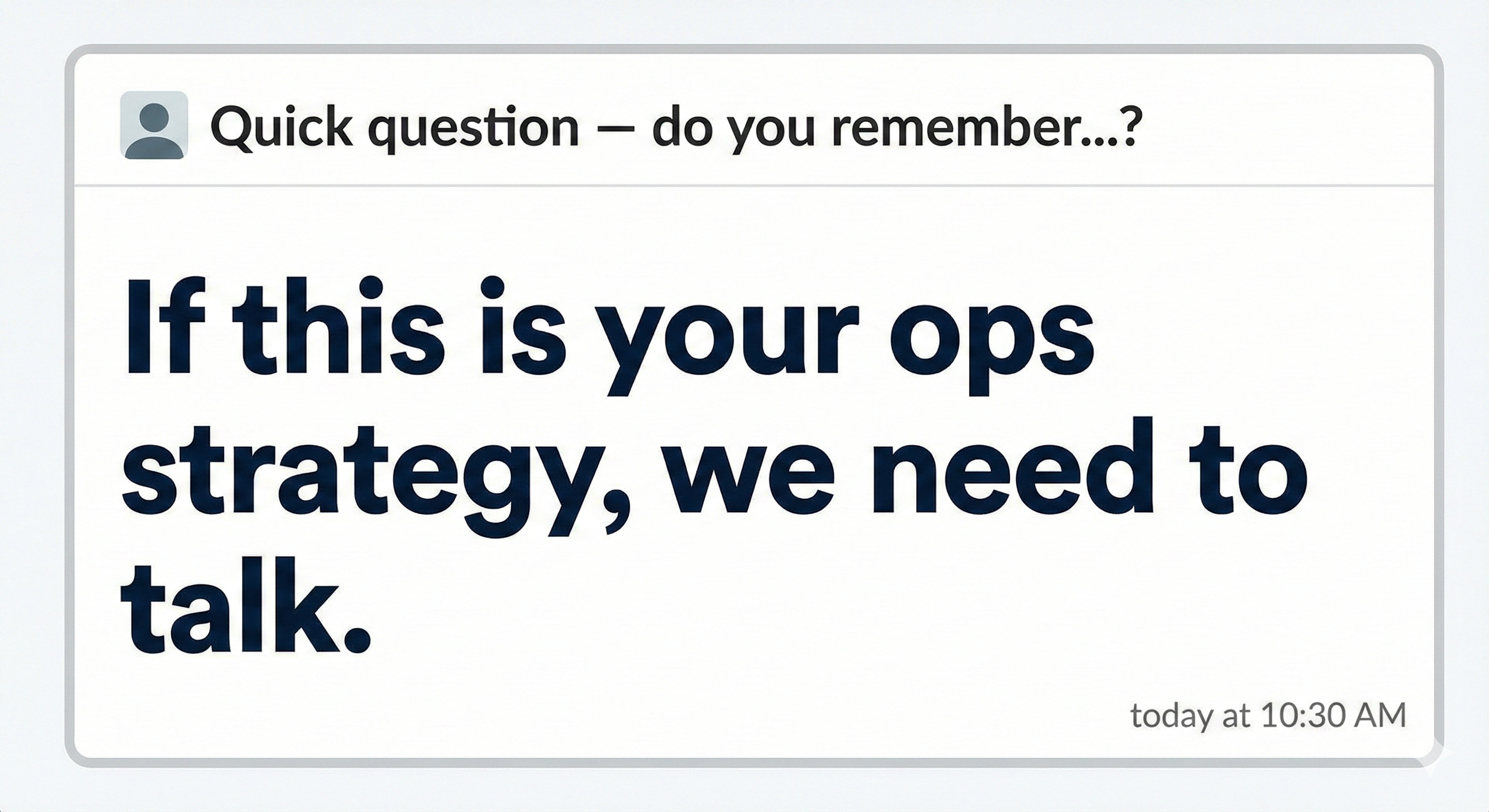
Everyone else just Slacks them:
“Quick question…”
“Do you remember…?”
On paper, that looks helpful.
In reality, it’s your operating model, and it’s a fragile one.
Why it’s so expensive
1. It caps your growth.
You can only grow as far as that person’s mental capacity. They become your ceiling.
2. It destroys focus.
Your most capable people are doing ping-pong memory work instead of deep work.
3. It hides risk.
If they got sick for two weeks, what would you be genuinely worried about? That’s your risk profile.
4. It trains everyone else not to think.
Why learn the system if you can just ask Sarah? Why check the doc if you don’t trust it’s updated?
Hello, systems problem.
The emotional load
The “whoever remembers” person is often the one with the highest emotional radar.
They don’t just remember tasks.
They remember feelings, promises, tensions.
They carry the quiet fear:
“If I drop this, things will actually fall apart.”
Talk about emotional and cognitive weight to carry! No wonder they are exhausted.
How you accidentally created this
It usually comes from a mix of:
Speed over clarity: “We’ll clean it up later.”
Muddy ownership: multiple people “kinda” own the same thing.
Docs no one trusts: the doc, the CRM, and reality don’t match, so people default to the human they trust.
So the business ends up running on memory and heroics.
A tiny experiment for this week
For the next 5 business days, have your “whoever remembers” person (or you) log every “Do you remember…?” / “Quick question about…” ping.
At the end of the week, look for patterns:
Is it always about the same process, client, or stage (onboarding, renewals, etc.)?
Is it usually the same 1–2 people asking?
Is it always the same person answering?
That’s your first diagnosis: the part of the business running on memory instead of system.
What “better” looks like (without a cathedral of docs)
You don’t need a 40-page SOP. Start small:
Turn one recurring “quick question” into a 3–5 step checklist or Loom.
Clarify one handoff between Sales and CS.
Make one simple “this is how we onboard a new client” doc everyone agrees to follow.
You’re not trying to eliminate the “whoever remembers” person.
You’re trying to shrink how much the company depends on their brain.
If this hit a little too close to home
If you immediately pictured someone on your team (or maybe even realized it’s you), that’s your signal.
You don’t have to fix everything this week.
But you probably do need to stop pretending this is sustainable.
If you want help naming the bottlenecks, my paid post
“10 Ops Questions That Reveal Your Hidden Bottlenecks”
walks through the exact questions I use at the start of almost every engagement to figure out where you’re over-relying on memory and heroics.
If you’re brave enough to ask them, you’re brave enough to fix what comes up.
Love this! I’ve been her! I would also add have a central location for all information (we used notion) so that “the one who remembers” can keep saying “check notion” and eventually people learn to go there first.
Love your content, Katie! Every startup has that one person who is the Google Doc for everything. It's the most relatable kind of mess.