

There’s a version of the AI conversation that makes my skin crawl.
The one where AI is framed as a shortcut.
Or a replacement.
Or a way to “remove human error” from messy systems.
That’s not what I’m doing.
That’s not actually what most early-stage companies need.
What they need is clarity.
Not more output.
Not faster dashboards.
Clarity about how work actually happens inside their company.
So here’s the truth:
I don’t use AI to design workflows in isolation.
I use AI to listen better at scale.
The real problem isn’t broken processes
When I walk into a company that feels chaotic, the issue is rarely just a missing SOP.
It’s usually this:
• People are doing the right work, but in slightly different ways
• Feedback exists, but it’s scattered across Slack, meetings, and side comments
• Leaders think they understand the friction, but they’re hearing it through filters
Everyone is carrying signal.
No one is holding the whole picture.
That’s where AI comes in for me. Not as a decider. As a pattern mirror.
How I actually use AI (at a high level)
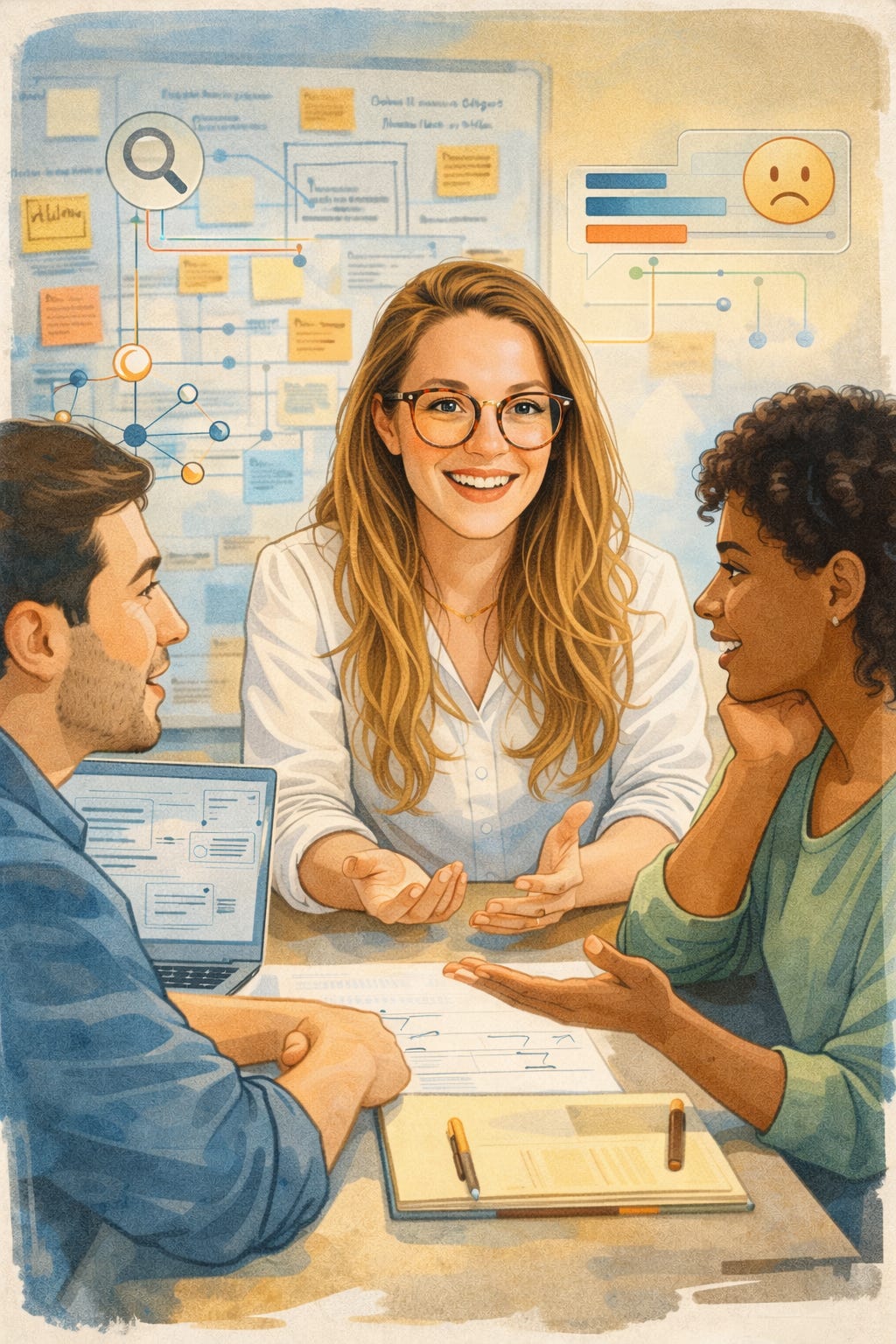
When I’m diagnosing workflows, I start with humans.
I talk to Sales.
CS.
Ops.
Sometimes Product.
Sometimes the person who’s quietly been duct-taping things together for six months. (Oh, hi, fellow operator and likely generalist.)
I gather:
• What feels slow
• Where they work around the system
• What they don’t trust
• What they wish someone would fix but never has
Then, and only then, does AI enter the room.
I use it to:
• Synthesize themes across roles
• Surface contradictions leadership might miss
• Highlight where process design fights human behavior
• Stress-test assumptions before I codify anything
To help me see what’s already there.
AI doesn’t design the workflow.
The team does.
AI helps me make sure I’m not privileging the loudest voice or my own bias.
Why this works better than “best practices”
Often, ops advice fails because it starts with set templates and frameworks.
Templates assume sameness.
People aren’t the same.
Neither are companies.
I always think of each new company I work with as its own organism. Patterns will be similar across these different organisms, but they are also incredibly unique.
A workflow that works beautifully for one team can quietly break another.
AI lets me evaluate:
• This company’s actual communication patterns
• This team’s tolerance for complexity
• This founder’s decision-making style
• This org’s current cognitive load
So the system fits the humans.
Not the other way around.
That’s the difference between something that looks good on paper and something people actually follow.
What I don’t share publicly (on purpose)
I’m open about my philosophy.
I’m selective about my mechanics.
The value isn’t in the prompt.
It’s in knowing what to ask, when to trust the signal, and when to ignore it.
It’s in experience.
Judgment.
Context.
AI is powerful, but without human discernment, it just scales confusion and craziness faster.
The future of operations isn’t automated. It’s attuned.
The operators who will matter most over the next decade aren’t the ones who move fastest.
They’re the ones who can:
• Hear nuance
• Design for real behavior
• Use AI as an amplifier, not an authority
That’s the work I’m doing.
Quietly.
Carefully.
With humans still very much at the center.
If you want simple frameworks for thinking about AI this way, and fewer hot takes about replacing people, I write here regularly.
Not everything needs to be optimized.
Some things just need to be understood.
A people-centric approach is crucial when implementing AI: treat it as a talent amplifier, not a replacement. Companies that rush deployments without training can face resistance and not optimal results, while smart ones (many already rehiring laid-off staff) prioritize upskilling teams.
AI amplifies insight, it doesn’t replace the human understanding that actually matters.