


Pretty much all early-stage teams have a sales funnel, but almost none have a real customer journey.
When you skip the journey, you end up with issues all over the board:
Confused hires
Dropped handoffs
Leaky onboarding
Customers who churn before they ever activate
I help founders build a map that fixes all of that.
Here’s what it includes and why it matters more than you think.
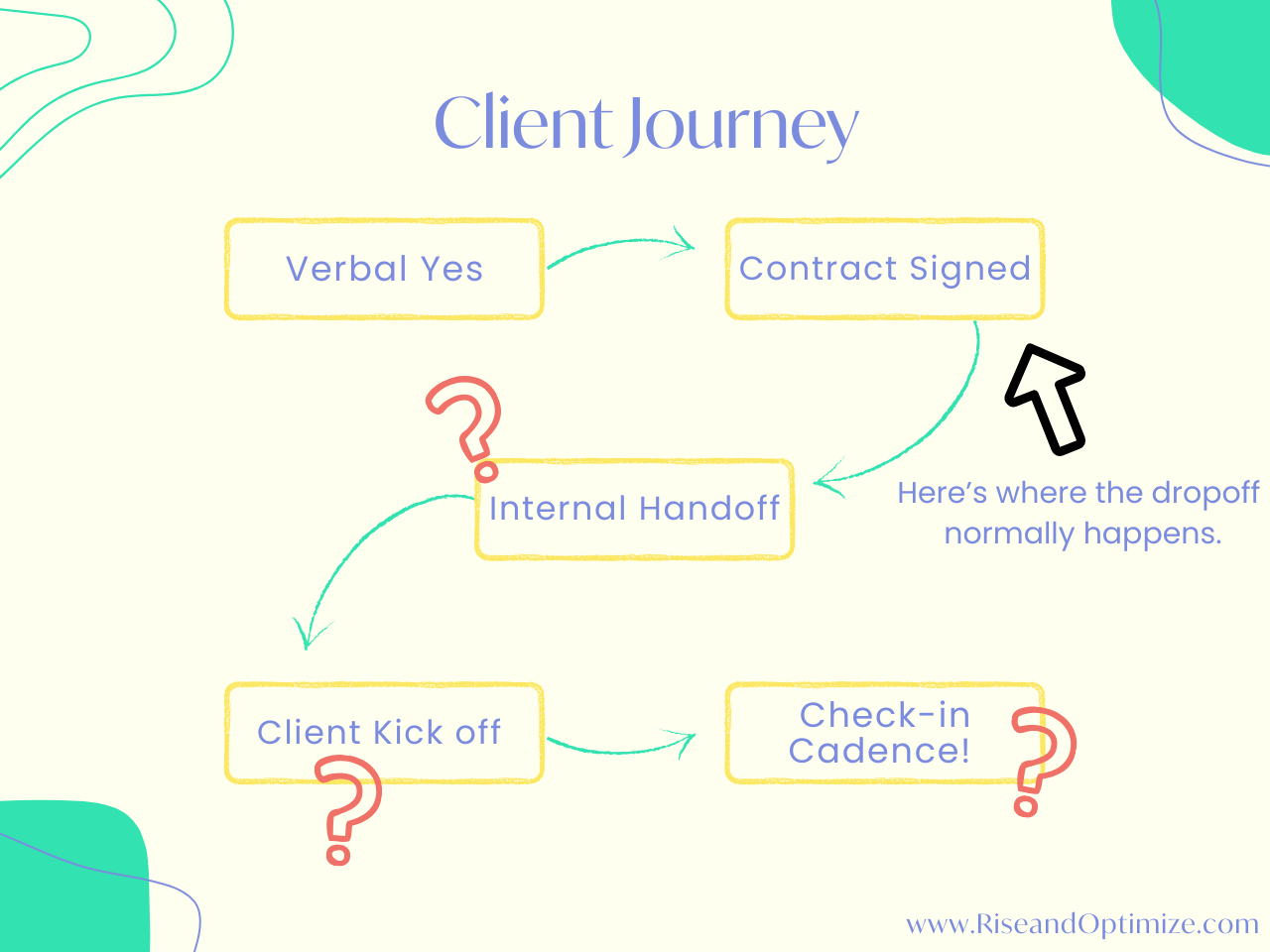
9 Things a Real Customer Journey Map Should Include
1. A Literal Flowchart
Start in Miro, FigJam, or Lucidchart. Yes, it’s a drawing. Yes, it matters.
You’re mapping how someone moves from lead → active customer → renewal (or churn…whomp.), with every detour and edge case included.
If your team can’t sketch this on a whiteboard, you’re winging it.
2. Data Sources & Owners
What tools store the data? Who owns each step?
This is where you find out that onboarding status is buried in a Slack DM and no one actually owns renewals.
Ownership brings clarity, and lack of it creates chaos.
3. What Actually Happens at Each Step
Not the aspirational version, the real one.
This is where you write down the awkward gaps, the duplicated steps, the 6-line email threads that should be templates by now.
4. Multiple Outcome Paths
Your flow should fork.
What happens if they ghost the proposal? (We’ve all been there)
If they sign but never show up to onboarding? (BTW, Who are these monsters??)
If they love onboarding but never expand?
Map the friction, and not just the fantasy.
5. Tool Stack Visibility
Where does each step happen?
CRM? Notion? Slack? Google Drive?
You’ll probably find three tools doing the same job, or worse, a key step living only in someone’s head.
6. SOP Integration
Once the map is clear, each phase should link to SOPs, templates, or internal docs.
Now your journey connects to training, hiring, and repeatability. It’s not just a strategy that gets buried.
7. Hiring Clarity
You’ll finally know what roles to hire and what they'll do.
Instead of saying “we need a CS person,” you’ll say, “we need someone to own Phase 3 and escalate issues in Phase 4.”
8. Org-Wide Alignment
Sales stops blaming CS.
Product gets clearer feedback.
The team starts asking, “Where in the journey did this break?” instead of, “Who dropped the ball?”
9. A Living Artifact
Your journey map evolves as you do.
New hires? Update the flow.
New tool? Re-map the touchpoint.
This becomes a core operating system, and not a one-and-done document. (Get ready to become real friendly with this map!)
💡 Why This Matters
Most early-stage pain is due to invisible gaps, unclear ownership, and duct-taped systems that don’t scale.
A customer journey map gives you the birds-eye view you’ve been missing.
It shows how you win deals, keep customers, and grow without dropping the ball.
🚀 Want This Map For Your Startup?
I build these maps in short sprints for early-stage teams who are:
Prepping to hire
Scaling GTM
Trying to reduce churn
Or just tired of explaining the same thing 6 different ways
I've got a couple sprint slots open this coming month. Want to see what this might look like for your team? Let’s talk!
This resonates, how do you think about the balance of getting it written down vs building a complex system around it? Does the approach differ at 10 customers vs 30 vs 100?
Agreed. But I think all startup advices should come with a préambule:
“These advice applies to stage x to y startups”
For example, I think this is great advice for early PMF startups. I’m not sure it’s worth spending time on it if the startup hasn’t close 10 customers yet. It would be an over-optimisation.