

Every founder on LinkedIn right now is posting about AI agents.
“We replaced our SDR workflow.”
“Our AI assistant handles support.”
“Ten people can now do the work of fifty!! WOOO HOO!”
Look…some of this IS real.
I use AI every single day. I LOVE it. It makes me feel like a superhuman sometimes. I use it to pressure test ideas, spot patterns, summarize information faster, draft first passes, and help structure workflows.
It’s an incredible sparring partner.
I still think we are about to see a whole lot of startups realize they never actually understood how work moved through their company in the first place.
Not sure if you’ve realized this from all my ranting, buut a shocking amount of startup infrastructure exists entirely in someone’s head.
Sam in Product has been here the longest, so he knows how onboarding works for that type of client.
Only the founder can approve pricing exceptions…after talking to Annie in Customer Success because she knows which customers are already upset.
Everyone references the same Google Sheet called FINAL_final_v2_USE_THIS_ONE.
There are seventeen Loom videos explaining the process. Nobody knows which one is current.
A new workflow gets created every time a weird client request comes in. Which means there are now 14 “temporary” processes living in Slack threads from nine months ago.
Still, somehow…through sheer force of human effort…things still mostly function.
This is the part I think the AI discourse is missing.
AI isn’t the real problem.
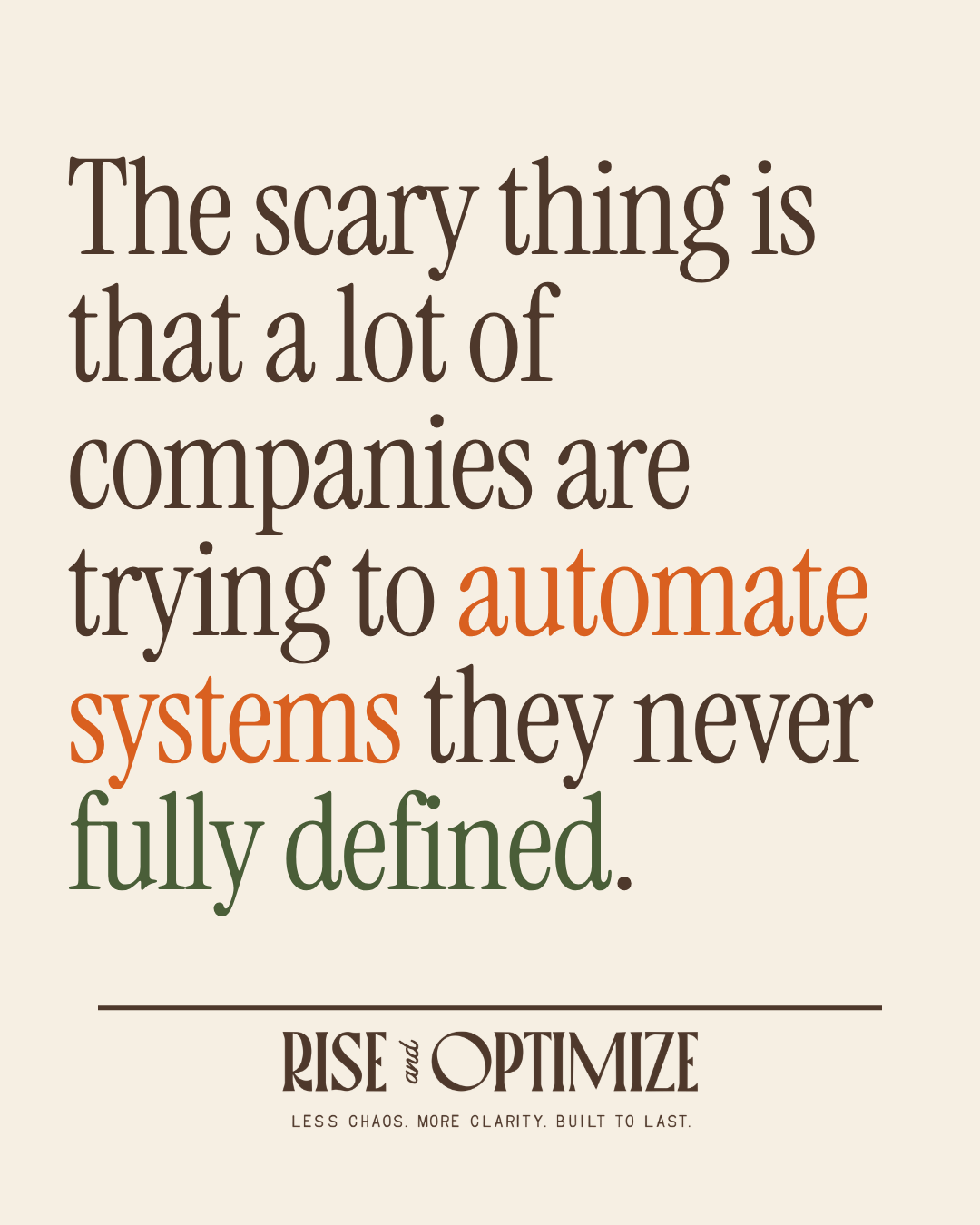
The scary thing is that a lot of companies are trying to automate systems they never fully defined.
AI is about to expose every startup operating on tribal knowledge.
Let’s be real…operators have known this for YEARS.
A lot of founders hear “operations” and think:
unnecessary structure
bureaucracy
slowing things down
admin work
What they don’t see is the amount of translation and coordination happening underneath the surface to keep the company functioning.
The ops person manually fixing CRM data before the board meeting.
The Customer Success lead preventing a client escalation before Sales even hears about it.
The manager spending half their week translating founder chaos into actionable work for the team.
The person in the 1:1 after the meeting playing therapist, translator, and systems analyst all at once. (Oh hi. That one is me.)
So when I see posts celebrating the elimination of entire teams, especially in Customer Success and operations-heavy environments, I definitely side-eye a little.
AI can absolutely accelerate good systems, but it also totally industrializes chaos.
You cannot toss garbage into AI and expect a masterpiece back.
If ownership is unclear, AI scales confusion.
If onboarding is inconsistent, congrats, the AI makes the inconsistency faster.
If nobody knows who approves what, AI just creates more noise at a higher speed.
If your company memory currently lives inside Slack DMs and “ask Sam,” eventually something breaks.
I think some founders are underestimating how much invisible labor has been holding their companies together this whole time.
Yes, it’s task completion, but it’s also:
Context.
Judgment.
Relationship management.
Cross-functional communication.
Pattern recognition.
Knowing when a customer sounds frustrated before they churn.
Knowing which process SHOULD be followed and which one everyone ignores because it broke three months ago.
That stuff matters.
A LOT.
The companies that survive this next phase of AI adoption won’t necessarily be the leanest.
They’ll be the companies that actually understand how work flows through their business.
Who owns decisions.
How information moves.
Where handoffs break.
What deserves automation.
What still requires human judgment.
For the operators reading this feeling mildly existential right now…truly, I think your value is about to become even clearer (if you manage the moment correctly).
The people who know how to build clarity, define workflows, create alignment, and use AI WITH guardrails are going to be incredibly valuable.
The future is not AI replacing every human in the org chart.
The future is humans who understand systems working alongside AI far better than companies operating on duct tape and tribal knowledge.
Cool. Your AI agent booked the meeting.
Does anyone know what happens after the contract gets signed?
Great practical take about missing decision context and the importance of tribal knowledge.
That's right 🔍👀