

TLDR: Founders aren't using AI wrong because they're using it too much. They're using it wrong because they stopped showing up for the decisions underneath it. You can use AI AND still be the one doing the thinking. Right now, most people are doing neither.
A founder texted me last week: “Can you look at this? I had AI run our retro notes, and I don’t actually know what we decided anymore.”
He read that back to himself before I could even respond. “That’s weird, right?”
Yeah. That’s weird.
He’s not lazy. He’s not checked out.

He’s running a sixteen-person team, closing deals, prepping for a raise, and doing what every founder does when the to-do list eats the day whole: he found the fastest way through it. AI wrote the retro summary. AI drafted the hiring rubric. AI ran point on a comp conversation when his Head of Sales asked for a raise.
None of that is the problem on its own. I use AI for half my day too (and we all know how much I LOVE a good shortcut).
The problem showed up two weeks later, when a client complained onboarding felt disorganized, and he couldn’t tell me why. He hadn’t actually sat inside the retro where his team named the exact reason. AI folded it into a tidy paragraph, he skimmed it, and the texture, the tension, the thing someone almost said but didn’t, all of it got smoothed out before it ever reached him.
He wasn’t in the room for his own company anymore. AI was.
Here’s the part nobody out there is saying out loud
The AI backlash crowd wants you to quit using it. That’s not my advice, and it’s not happening anyway.
My advice: use it AND stay the one doing the thinking.
Those are two different jobs. Lately, founders are only doing one of them.
A recent BCG study of C-suite leaders found that half are already seeing this exact gap show up in their own teams, and most expect it to get worse over the next few years. The skill they flagged as most at risk? Judgment and decision-making. The one thing you can’t hand off and still call yourself the founder.
Judgment isn’t a task. It’s a muscle. You use AI to clear the noise around a decision. You still have to make the call, sit in the discomfort of not knowing, and watch what happens when you’re wrong. That’s the whole loop. Skip the middle two steps and the muscle goes soft, even while your calendar looks more efficient than ever.
What this actually looks like when it’s working
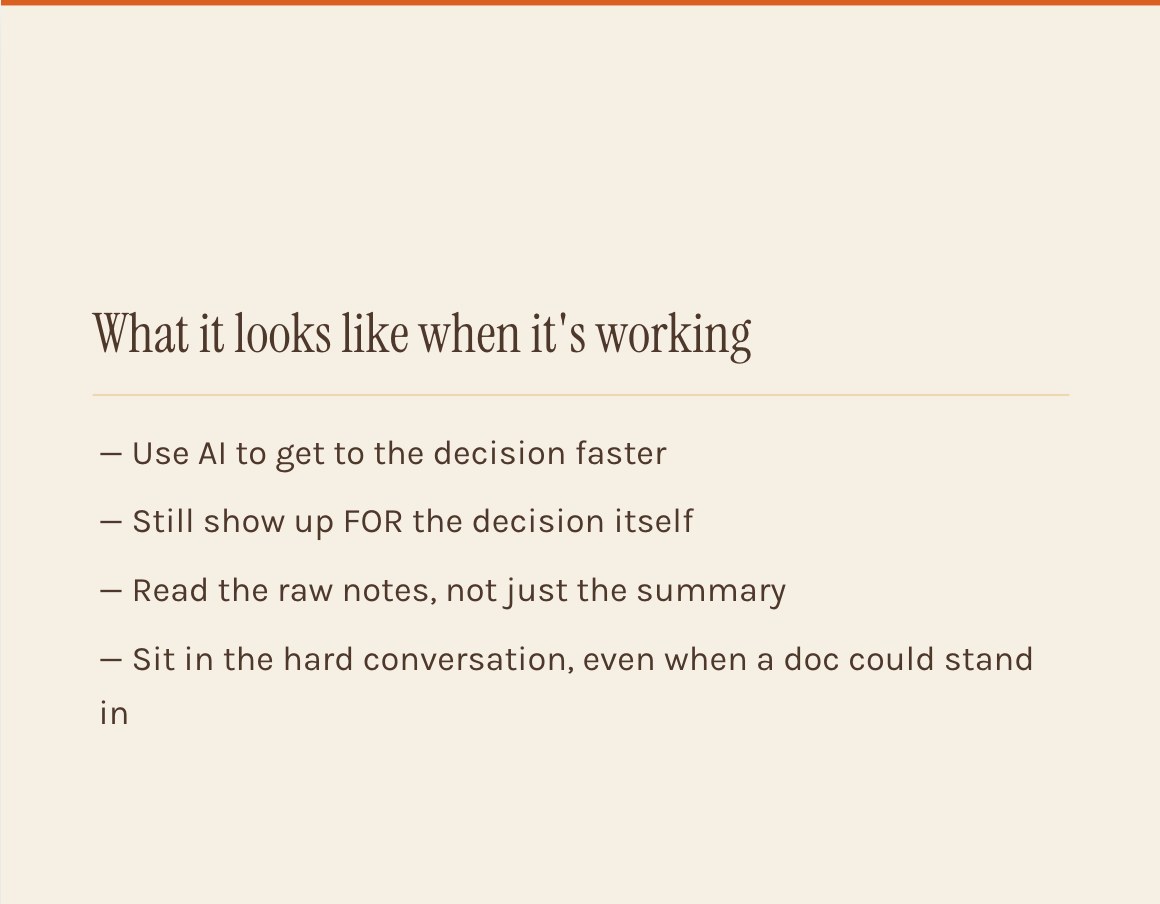
The founders I trust most right now use AI to get to the decision faster, then still show up FOR the decision itself. They read the raw retro notes, not just the summary. They sit in on the hard conversation even when a doc could technically stand in for them. They know the difference between delegating a task and delegating their own understanding of their company.
You didn’t get slower or dumber. You just started mistaking the summary for the thing itself.
One question before you close this
Where’s the one place in your business right now where you’re reading the AI summary instead of sitting in the actual room? Be REAL, REAL honest.
...
KB
This is a phenomenal, sharp-as-hell diagnosis of modern leadership, Katie. You have pinpointed the exact behavioral failure mode of the current corporate landscape: proximinal absence.
What you’ve beautifully captured with the founder who "lost the texture" of his own retro notes is a textbook example of the Zero-Veracity Trap.
Generative utilities are fundamentally built to smooth out variance. They remove tension, eliminate human friction, and fold messy realities into tidy paragraphs. But in corporate governance and enterprise leadership, the friction is the data.The thing someone almost said but didn’t, the tension in the room, the raw unfiltered feedback—that is where true corporate alpha lives. When leaders mistake the synthetic summary for the operational reality, they are actively outsourcing their intuition.
In my upcoming framework, I am trying to mathematically quantify this exact risk. This Wednesday in The Unclonable Boardroom, I am releasing the foundations of the Trust Capital Audit Index (TCAI) to help boards and founders audit this. We look at Rh (Human-Verified Relationship Loops)—the volume and depth of direct, unsummarized, non-synthetic human proximity.
To answer your brilliant closing question: I see founders reading the summary instead of sitting in the room most often during executive succession and alignment debates. They look at a candidate's optimized profile rather than building unmediated relationship loops.
How are you advising founders to structurally build "friction checks" back into their calendars so they don't accidentally automate away their own situational awareness? Let's collaborate on this.
This is so true. I’ve been seeing it myself — people I work with rely too much on the AI notetaker, and they don’t pay attention during the meeting they’re in. The AI notetaker summary gets it wrong sometimes! Or it summarizes a decision without the right context, and it takes more work to backtrack and untangle what actually happened in the meeting.
Such a good reminder to use AI as a partner and not to outsource your thinking and judgment to it!